
Eliminate travel friction with Integrated Ground Transport & Meet and Assist. Ensure a seamless, secure gate-to-door journey with coordinated terminal handling.
-
Select options This product has multiple variants. The options may be chosen on the product page
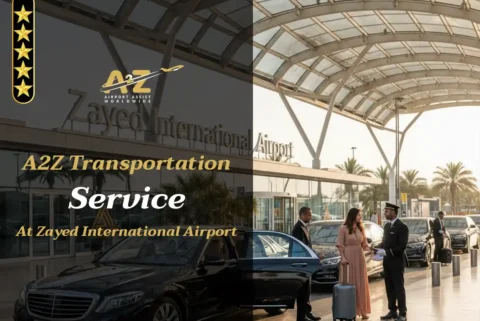
A2Z Transportation Service – Departure At Zayed International Airport
Select options This product has multiple variants. The options may be chosen on the product page -
Select options This product has multiple variants. The options may be chosen on the product page
A2Z Transportation Service Arrival At Zayed International Airport
Select options This product has multiple variants. The options may be chosen on the product page
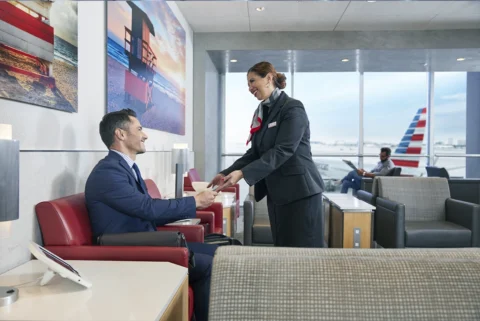
In today’s travel environment, the rarest resource isn’t comfort — it’s time.
Airlines have optimized cabins, lounges, and loyalty programs. Yet the most unpredictable part of any journey still happens on the ground: the space between aircraft arrival and final destination.
This “ground gap” — the fragmented period after landing — is where delays, confusion, fatigue, and risk accumulate.
Forward-thinking companies and high-efficiency travelers are now solving this problem through Integrated Ground Transport & Meet and Assist. It’s not about adding luxury. It’s about removing friction and transforming disconnected steps into one continuous, managed transition.
Eliminating Travel Friction at the Airport
Most arrival processes are reactive.
A traveler lands, waits to disembark, navigates immigration, retrieves luggage, and only then begins coordinating transport. Drivers circle parking zones. Messages are exchanged. Phone batteries drain. Time is lost.
Integrated Ground Transport replaces that reactive model with structured terminal logistics.
Instead of separate services, airport assistance and chauffeur coordination operate as a single ecosystem.
How It Works
The terminal assistant tracks the inbound flight in real time.
The chauffeur receives synchronized updates on passenger progress.
Vehicle positioning is timed to coincide with terminal exit.
The result is simple but powerful: no waiting, no secondary coordination, no roadside confusion.
In major hubs such as John F. Kennedy International Airport or Dubai International Airport, where curbside congestion and traffic density fluctuate by the minute, synchronization makes the difference between efficiency and delay.
The transition from aircraft door to executive vehicle becomes fluid.
Secure Gate-to-Door Transitions
For corporate travel managers, the airport is not merely a transit point — it’s a risk environment.
When airport assistance and ground transport are booked independently, a visibility gap appears. The passenger exits a supervised terminal space and enters an uncontrolled public zone to locate transportation.
Integrated executive mobility closes that gap.
From arrival gate to vehicle door, the passenger remains within a structured service perimeter.
Why This Matters
- Verified chauffeurs with pre-approved credentials
- Known vehicle details prior to arrival
- Direct escort to pickup zone
- No exposure to unverified ride-share solicitation
This “secure bubble” approach is increasingly important for organizations with global operations.
In cities like London and Singapore, where business travel volume is intense and curbside zones are tightly regulated, controlled transitions protect both time and personal security.
For companies managing international teams, consistency in safety standards is not optional — it is operational policy.
Luggage Logistics: From Carousel to Trunk Without Friction
Travel fatigue often begins with something simple: physical handling.
Multiple suitcases. Carry-on bags. Presentation materials. Personal items.
Managing luggage while navigating a crowded arrivals hall is not efficient, especially after long-haul travel.
With integrated professional airport assistance:
The meet-and-assist agent monitors the baggage carousel.
Porterage is coordinated immediately upon collection.
Luggage is transported directly to the dedicated vehicle.
Items are loaded securely under supervision.
The traveler remains hands-free.
This hands-off approach changes the arrival experience. Instead of juggling equipment and scanning parking lanes, the passenger exits calmly, transitions into the vehicle, and departs without delay.
Terminal logistics are no longer an afterthought — they are part of the mobility strategy.
Centralized Travel Logistics for Corporations
Administrative complexity is another hidden cost of fragmented travel.
Separate bookings for airport assistance and transportation mean:
Multiple invoices
Separate vendor contacts
Duplicate approval processes
Complicated reconciliation
An integrated model consolidates the entire “gate-to-door” journey under one operational framework.
Financial Advantages
- Clear Budget Forecasting
A single, predictable cost structure for arrival logistics. - Simplified Billing
One invoice, one service provider, one point of accountability. - Reduced Administrative Waste
Fewer email chains, fewer last-minute vendor adjustments.
For multinational organizations managing recurring executive travel into hubs like Paris or Doha, centralized coordination significantly reduces back-office friction.
Executive Mobility in a Time-Sensitive World
At senior levels of business, time efficiency is measurable.
When an executive lands:
Meetings are scheduled tightly.
Drivers are pre-booked by assistants.
Event timelines depend on punctual arrival.
A 20-minute curbside delay may appear minor — but across dozens of annual trips, inefficiencies compound.
Integrated Ground Transport treats the airport as a controlled operational zone rather than a variable environment.
This approach aligns with how corporations already manage other logistical systems: structured, predictable, performance-driven.
Why the Traditional Model Is Becoming Obsolete
The old model assumes:
The airport assistant finishes their task at baggage claim.
The driver waits independently outside.
The traveler bridges the gap alone.
But modern travel demands continuity. Airports are larger. Passenger volumes are higher. Security protocols are stricter. Traffic patterns are more volatile.
Fragmented services introduce micro-delays at every step. Integration eliminates those seams.
The A2Z Approach to Professional Airport Assistance
Companies like A2Z Airport Assist are adapting to this shift by aligning meet-and-assist teams with ground transport partners under a unified operational model. Rather than offering isolated services, the focus is on:
Coordinated scheduling
Real-time communication between teams
Defined service-level standards
Structured accountability
This reflects the broader evolution of airport assistance from hospitality add-on to logistical infrastructure.

The Future of Frictionless Travel
The new benchmark for premium travel is no longer defined by lounge access or cabin class.
It is defined by absence of friction.
Integrated Ground Transport & Meet and Assist represents a practical evolution in travel management:
Continuous supervision from gate to vehicle
Predictable transfer timing
Hands-free luggage handling
Centralized billing
Enhanced corporate oversight
In a world where executive mobility, duty of care, and operational efficiency matter more than ever, seamless terminal logistics are becoming the standard — not the exception.
The future of travel is not about adding more services.
It is about connecting them intelligently.
Data-Driven Mobility: How Real-Time Intelligence Powers Integrated Ground Transport
The strength of Integrated Ground Transport & Meet and Assist does not rely solely on human coordination. It is increasingly powered by real-time operational intelligence.
Modern airport ecosystems are dynamic. Arrival gates change. Aircraft park at remote stands. Immigration processing times fluctuate. Traffic congestion outside terminals can vary by the minute.
Without data synchronization, even well-planned transfers can become reactive.
Live Flight Monitoring & Predictive Adjustments
Integrated terminal logistics begin long before landing. Professional airport assistance teams monitor:
Estimated time of arrival (ETA) updates
Gate assignment changes
Runway sequencing delays
Early arrivals or airborne holding patterns
If an aircraft lands ahead of schedule at airports such as Frankfurt Airport, chauffeur positioning is adjusted immediately.
If arrival is delayed at Dubai International Airport during peak traffic windows, curbside strategy is modified to prevent idle waiting fees or congestion exposure.
This predictive layer converts uncertainty into managed timing.
Terminal Flow Intelligence
Airports operate in waves. Multiple long-haul arrivals within a 30-minute window can temporarily increase:
Immigration wait times
Baggage carousel congestion
Curbside vehicle density
Integrated executive mobility providers assess these flow patterns in advance. By analyzing arrival clusters, they can:
Deploy additional terminal staff
Redirect pickup zones when permitted
Adjust internal routing for faster exit
The goal is not speed alone — it is flow optimization.
Chauffeur Synchronization Protocol
Traditional airport pickups rely on post-arrival communication:
“Have you cleared immigration?”
“I’m waiting outside.”
“Which door are you at?”
Integrated models eliminate this guesswork.
Instead:
The terminal assistant confirms clearance milestones.
Chauffeurs receive precise timing instructions.
Vehicle approach is coordinated within minutes of terminal exit.
At high-density hubs such as Heathrow Airport, where curbside dwell time is tightly regulated, accurate synchronization prevents penalties and unnecessary circulation.
Executive Reporting & Transparency
For corporate clients, data transparency strengthens accountability.
Integrated providers can generate:
Arrival-to-vehicle time metrics
Delay impact reports
Service completion confirmations
Incident escalation logs
This measurable framework supports internal reporting requirements and strengthens duty-of-care documentation.
Executive mobility becomes auditable, not anecdotal.
Strategic Implication for Corporate Travel Programs
As global travel volumes continue to rise, variability increases.
Organizations that rely on disconnected service providers face higher unpredictability.
By adopting data-driven Integrated Ground Transport and Professional Airport Assistance, corporations transition from reactive problem-solving to proactive mobility management.
The airport is no longer a chaotic transit space — it becomes a controlled extension of the company’s operational ecosystem.
In modern executive travel, intelligence is efficiency.
FAQ
The primary benefit is the elimination of the “transfer gap.” By coordinating the terminal assistant with a professional chauffeur, travelers avoid the stress of navigating crowded arrival halls to find their driver. This integrated approach ensures a seamless gate-to-door transition, where the vehicle is positioned exactly when the passenger exits, saving an average of 20–30 minutes per arrival.
Professional airport assistance provides a completely hands-free luggage experience. An agent monitors the baggage carousel, coordinates porterage immediately upon collection, and supervises the loading of items directly into the executive vehicle. This allows the traveler to focus on their itinerary and avoid the physical fatigue of managing heavy bags through a busy terminal.
Yes. Integrated executive mobility creates a “secure service bubble” that meets corporate Duty of Care standards. Unlike unvetted ride-shares, integrated services use pre-approved chauffeurs and known vehicle details. The traveler is escorted directly from the gate to the vehicle door, eliminating exposure to unauthorized solicitations and uncontrolled public zones.
Absolutely. For international transit and connecting flights, integrated services prioritize speed and comfort. An assistant meets you at the aircraft door, fast-tracks you through security or transfer desks, and can coordinate lounge access or a private chauffeur for transfers between terminals (such as the Al Majlis service at Dubai International Airport).
Facilitated payments simplify centralized travel logistics by consolidating multiple services—such as meet and greet, porterage, and ground transport—into a single invoice. For corporations, this reduces administrative waste, provides clear budget forecasting, and eliminates the need for employees to manage multiple receipts in different currencies.