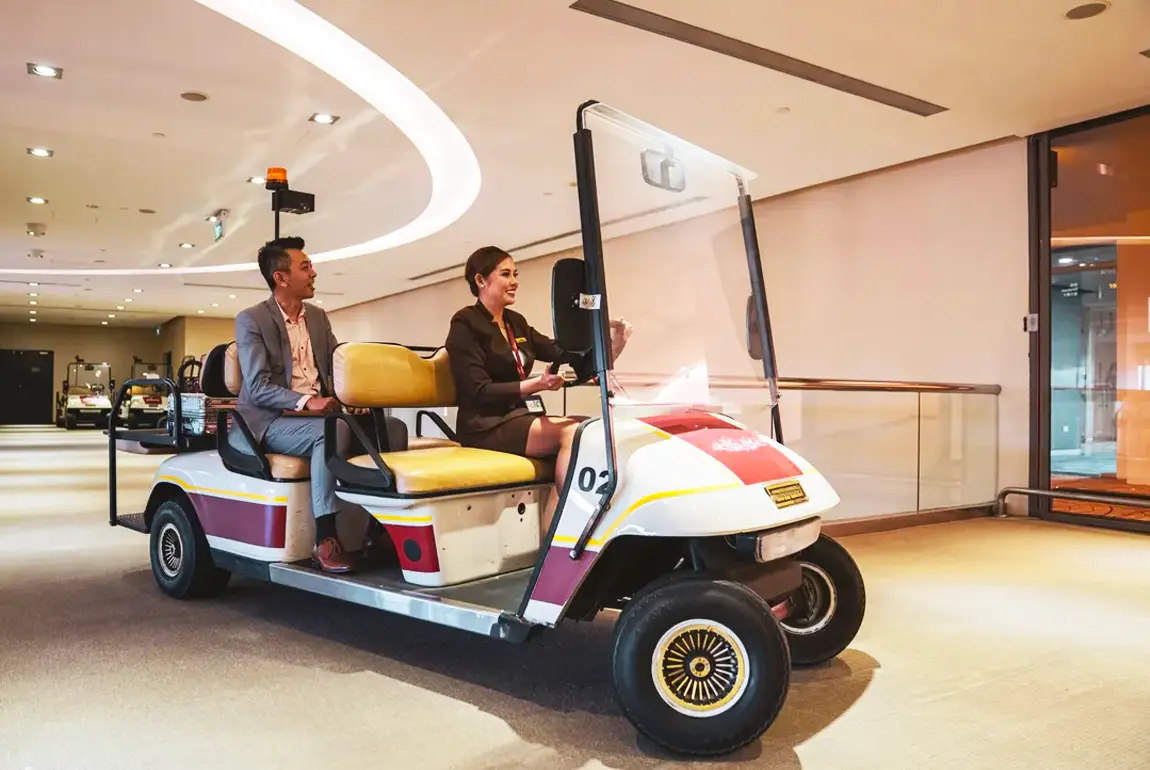
Discover how Airport Buggy and Escort Services help travelers with mobility needs, heavy luggage, or long connections save time.
Airports are getting bigger. Terminals are expanding. Walking distances between gates can exceed one kilometer in major international hubs.
For many travelers, that’s an inconvenience.
For others, it’s a serious obstacle.
This is where airport buggy services, airport escort buggy support, and structured luggage assistance at airports become critical — not luxury add-ons, but operational mobility solutions.
In this guide, we break down how these services work, who truly benefits from them, and why they are becoming one of the most practical airport assistance tools in 2026.
What Are Airport Buggy Services?
Airport buggy services provide electric cart transportation inside terminals. These vehicles are typically operated by trained airport staff or authorized assistance providers.
They are designed to:
Transport passengers between gates
Assist during long layovers
Support mobility-restricted travelers
Reduce walking time in oversized terminals
Unlike wheelchairs, buggies are not strictly medical. They are mobility accelerators.
In large hubs such as Dubai International Airport and Istanbul Airport, walking time between terminals can exceed 20–30 minutes.
A buggy can reduce that to 5–10 minutes.
What Is an Airport Escort Buggy?
An airport escort buggy combines transportation with guided assistance.
Instead of simply riding between points, passengers receive:
Personal escort from arrival gate
Navigation through transfer corridors
Guidance to security or immigration
Support at baggage claim
Delivery to departure gate
This service is particularly valuable during:
Tight connections
Language barriers
First-time international travel
Large unfamiliar terminals
Escort + mobility = time optimization.
Why Walking Time Is the Hidden Delay Factor
When travelers think about delays, they consider:
Immigration lines
Security checks
Boarding queues
But they often underestimate walking time.
At airports like Frankfurt Airport, some gate-to-gate transfers can require:
Escalator changes
Shuttle trains
Multi-level navigation
Even healthy travelers can struggle when:
Carrying cabin bags
Traveling with children
Managing elderly companions
Buggy services eliminate this friction.
Who Needs Airport Buggy Services Most?
Not every passenger requires mobility support. However, several categories benefit significantly.
Elderly Travelers
Long corridors, escalators, and rushed transfers can be physically exhausting. An airport escort buggy ensures:
Reduced physical strain
Faster transfers
Supervised navigation
Less anxiety during busy travel waves
Passengers With Temporary Injuries
Travelers with:
Knee injuries
Back problems
Post-surgery recovery
Sprains or fractures
may not require a wheelchair but cannot walk long distances comfortably.
Buggy services provide flexible support without full medical categorization.
Families With Young Children
Parents managing:
Strollers
Hand luggage
Diaper bags
Tired toddlers
benefit greatly from luggage assistance at airports combined with escort transport.
In major hubs like Heathrow Airport, long corridors plus boarding deadlines create stress for families.
Buggy support reduces chaos.
Business Travelers With Tight Schedules
Time-sensitive passengers often need to:
Move rapidly between terminals
Reach gates before boarding cut-off
Avoid unnecessary walking delays
An airport escort buggy transforms terminal navigation into a structured process.
For executives, time equals money.
Travelers With Heavy Cabin Luggage
Even carry-on-only passengers may transport:
Professional equipment
Trade show materials
Electronics
Presentation kits
Luggage assistance at airports combined with buggy transport protects both time and physical energy.
How Much Time Can You Actually Save?
Time savings depend on airport size. Estimated averages:
| Scenario | Walking Time | Buggy Transfer |
|---|---|---|
| Same terminal long corridor | 15–20 min | 5–8 min |
| Terminal change | 25–35 min | 10–15 min |
| Peak traffic navigation | 30+ min | 12–18 min |
In large international hubs such as Charles de Gaulle Airport, mobility assistance can cut transfer time by 40–60%.
During short layovers, that margin is decisive.
Luggage Assistance at Airports: An Underrated Benefit
Mobility isn’t the only factor. Luggage assistance services typically include:
Trolley management
Oversized baggage supervision
Coordinated baggage claim monitoring
Porter support
This is especially useful for:
Senior travelers
Luxury travelers
Group arrivals
Medical travelers carrying equipment
Reducing physical strain improves overall travel comfort.
Psychological Benefits of Escort Mobility
Airport stress often results from uncertainty. Passengers worry about:
Getting lost
Missing boarding
Not understanding signage
Navigating foreign-language announcements
An escort buggy service provides:
Clear direction
Constant supervision
Real-time flight updates
Immediate response to gate changes
The reduction in anxiety is as valuable as the time saved.
Are Airport Buggy Services Available Everywhere?
Availability depends on:
Airport size
Terminal infrastructure
Local regulations
Service provider authorization
Large global hubs generally provide buggy access, while smaller regional airports may offer limited availability. Professional assistance providers such as A2Z Airport Assist coordinate buggy access where permitted and integrate it into broader airport support services.
Booking Considerations
If you plan to request airport buggy services:
Book at least 24–48 hours in advance
Confirm terminal details
Provide medical or mobility information if relevant
Clarify whether service includes luggage assistance
Advance coordination ensures staff availability.

Airport Buggy vs Wheelchair: Key Difference
| Feature | Buggy | Wheelchair |
|---|---|---|
| Medical necessity | Not required | Often required |
| Speed | Faster | Slower |
| Passenger capacity | 2–5 passengers | 1 passenger |
| Best for | Long distances | Reduced mobility |
When Is It Absolutely Worth Booking?
Airport escort buggy services are highly recommended when:
Walking distance exceeds 15 minutes
Layover is under 90 minutes
Passenger mobility is limited
Traveling with children or elderly family
Carrying significant hand luggage
In these scenarios, the cost is minor compared to the physical and logistical benefit.
Airport Architecture & Walking Distance: Why Modern Terminals Make Buggy Services Essential
Over the past decade, airport infrastructure has expanded dramatically. Modern terminals are no longer compact buildings — they are integrated transport ecosystems combining retail zones, satellite concourses, automated trains, and multi-level processing areas.
For passengers, this architectural evolution has one direct consequence:
Longer walking distances.
The Rise of Mega-Terminals
Major global hubs are designed to process tens of millions of passengers annually. To accommodate this traffic, airports have built:
Satellite concourses
Remote gates
Underground transfer corridors
Inter-terminal train systems
Multi-story departure halls
For example, Hamad International Airport spans vast walking corridors between gates, while Beijing Daxing International Airport is one of the largest single-building airport terminals in the world.
Even healthy travelers can underestimate the time and energy required to cross these structures.
Average Walking Distances in Large Airports
Studies of passenger movement patterns in mega-hubs show that travelers may walk:
1 to 2 kilometers during a simple departure
2+ kilometers during certain international transfers
Up to 3 kilometers when changing terminals
Add in:
Carry-on luggage
Security re-check routing
Boarding cut-off pressure
The physical demand becomes substantial.
This is precisely where airport buggy services provide measurable operational advantage.
Vertical Movement & Hidden Fatigue
Distance alone is not the only factor. Modern airports often require:
Escalator transitions
Elevator usage
Moving walkways
Shuttle trains
Frequent vertical movement increases fatigue — especially for elderly passengers or travelers recovering from injury.
An airport escort buggy eliminates most of this physical strain by navigating optimized internal pathways.
Retail Layout & Indirect Routing
Airports increasingly use commercial zoning strategies that route passengers through:
Duty-free corridors
Luxury retail spaces
Food courts
Entertainment zones
While commercially effective, these layouts increase walking distance and create directional confusion.
In high-traffic environments such as Singapore Changi Airport, navigation can be overwhelming during peak hours.
Escort mobility ensures direct routing rather than retail detours.
Connection Pressure in Expanding Hubs
As airport capacity increases, connection complexity grows.
Long-haul aircraft typically park at distant gates. Wide-body deplaning alone can take 10–15 minutes before passengers even begin walking.
Without structured movement support, valuable connection time is lost simply covering ground distance.
For travelers with tight schedules, the time saved by buggy transport can determine whether a connection is comfortable or stressful.
Why This Trend Will Continue in 2026 and Beyond
Airport expansion is ongoing worldwide. Major development projects are underway in hubs such as:
John F. Kennedy International Airport
Istanbul Airport
As passenger volumes rise and terminals grow larger, walking distances will not decrease — they will increase.
This structural reality means mobility services are becoming essential infrastructure components rather than optional upgrades.
As airports grow larger and connections more complex, VIP airport services are expected to become an integral part of international travel planning, not just for elites but for anyone seeking reliability and comfort in an increasingly demanding travel environment.
Airport Buggy and Escort Services: Final Assessment
Airport mobility is no longer a minor detail — it is a strategic part of modern travel planning.
As airports expand and passenger traffic grows, airport buggy services, airport escort buggy support, and structured luggage assistance at airports provide measurable advantages:
Reduced walking time
Lower stress levels
Improved punctuality
Enhanced comfort
For elderly passengers, families, injured travelers, and time-sensitive professionals, these services are not indulgent — they are practical tools that transform the airport experience from exhausting to efficient.
In 2026, smart travelers optimize not just their flight — but their movement inside the terminal.